Wednesday, June 30, 2010

July 4 in DC


America is a tune.  It must be sung together.  ~Gerald Stanley Lee

Happy Birthday America!

Friday, June 25, 2010

Happy Birthday Alazar!


Four years ago today we mailed in our application to the adoption agency. Unknown to us on that same day on the other side of the world our son was being born. One year later we were in Ethiopia holding him. And today surrounded by Star Wars and Toy Story toys we celebrate his turning four. What a joy he has been and continues to be to us. We are so blessed.

Wednesday, June 23, 2010

Wordless Wednesday- Ethiopia, One Pic is Not Enough...

 Three years ago this week we were on a life-changing trip to Ethiopia, an extraordinary country.


The housing


The faces


The scenery


The housework


The market


The reason


Friday, June 18, 2010

Kindermusik for math, literacy, and social skills

The initial view of a music class is that it is directed specifically at children whose parents aspire for them to become accomplished musicians. While musicianship is certainly obtained, Kindermusik actually focuses on teaching math, literacy, and social-emotional skills and it does so through the three different learning styles- audio/verbal, visual, and kinesthetic.

Your audio/verbal learner in music class: Your little singer is given many opportunities to learn and express themselves in Kindermusik class. Each semester your child receives a CD with the entire semesters repertoire. This will probably be their favorite part of the take home materials. They will be introduced to early math skills through singing counting songs musical scales and hearing the complexities of classical music. They will be introduced to the very important skill of active listening by learning about sounds and then listening for them. Active listening and repeating of rhymes is a building block to childhood literacy. Listening to a wide variety of music including music in different languages prepares your child for multilingual literacy as well. Socially your child learns through the ensemble effort of singing together. They also learn the turn taking skill through call and response. The skill of your child's actual singing is secondary to these important life skills.

Your visual learner in music class: Your reader will particularly enjoy the story time in Kindermusik class and their favorite part of the take home material will most likely be the book. They will also like the bright posters on the walls and the colored scarves we dance with. As we sit, stand and move in class your child will be observing visually and will be introduced to early math skills and even geometry as they begin to understand spacial awareness. They will see numbers as we count on our fingers while singing and will notice the patterns as we shake shakers up high for four beats then down low for four beats. In story time they will enjoy looking at the pictures and words in the book, beginning to define the two. They will enjoy matching pictures to sounds and they will learn the early literacy skill of reading left to right. Socially your visual learner will learn to relate with others through turn taking with instruments and having the opportunity to watch other children interact. They will learn social cues like standing when they see the teacher stand and clapping when they see others clap. Important building blocks to your child's success are found in such a class.

Your kinesthetic learner in music class: Your tiny dancer will love all of the hands on time they have with scarves and instruments in Kindermusik class. In fact the instrument they are given as part of the take home materials may be their favorite. Dancing patterns and clapping steady beats are both early math skills your child will enjoy. Counting on fingers, hopping three times in a row, all to fun music instills these math skills. Literacy will be learned through understanding the meaning of words through movement. Up, down, fast, slow will make sense to them as they are actively involved, enriching their vocabulary. Socially your kinesthetic learner will thrive from turn taking, circle dancing, holding hands with other children, and partner dancing. All of these will help your child relate to others in an enjoyable environment. High energy children with a great need for movement are well respected and appreciated in class while learning essential skills.

Kindermusik is an international music and movement program for children ages 0-7 and is the originator of the mommy and me style class. They combine years of research with modern discoveries to create an ideal learning space for your young child. For more information or to enroll in a Kindermusik class go to www.KindermusikwithMsB.com.

Wednesday, June 16, 2010

Wordless Wednesday - Tim in Uganda


This is my husband Tim. He has been at an orphanage in Uganda for the past two weeks. I miss him dearly but when I see pics like these, I get it.

Tuesday, June 15, 2010

Does your child feel loved by you?

I love my children wholeheartedly. With every fiber in me, I love them. But, and that's a big but, I don't always think they know it and definitely don't always think they feel it. So I've been doing some studying on the topic and I'll pass on what I've discovered.

It seems there are some ways that show love to all children and then there is also a breakdown of ways, referred to as love languages, that are more individualized. Every child needs certain things to feel loved and our responsibility as parents is to continually use these. Children who feel loved are more likely to succeed in life and relationships than children who are loved but don't feel it.

One of the things crucial to all children is eye contact. Looking your child straight in the eye and maintaining that eye contact shows your child that they have your undivided attention. Also, eye contact conveys honesty. Children also need one on one time. This one is harder.  And the bigger your family, the harder yet. Finding individualized time for each of our children is going to take time and sacrifice. I'm willing but don't always feel able. I'm going to have to work hard on this one. The third crucial part for all children is discipline. Discipline is training and setting boundaries. It includes punishment but that's not the main focus of discipline. The idea of discipline is to eventually lead them to self-discipline, self-control. We all know how important that is in our lives. It's our responsibility to direct our children in that and, amazingly, doing so helps them understand that whee love them. So eye contact, one on one time, and discipline are the foundations.

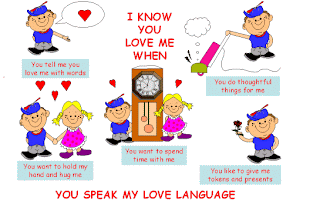
Beyond those basic are the five love languages. Each of us, including our children, speaks and understands a different love language. The five languages as laid out by Gary Chapman PhD and Ross Campbell MD in the book "The Five Love Languages of Children" are quality time, words of affirmation, gifts, acts of service, and physical touch. Though each of these ought to be expressed, one of these speaks loudest to each child.  A child whose language is physical touch will love hugs and kisses, patty cake, tickling, spinning and dancing together and riding piggy back. The child whose language acts of service will really appreciate you making something for them or even doing their chores one day for a special treat. Quality time speakers will really feel loved by the one on one time all our children need. Mommy and me classes are great for these kids. Children who feel loved by words of affirmation will love the cheerleader in you. Saying "I love you" and "great job" or "good try" will mean more to them  than the other languages. A child whose love language is gifts places great meaning in gifts, showing love by giving and feeling love by receiving gifts. Figuring out your child's love language can be done by asking "would you rather" questions. "I have some free-time next Saturday. Would you rather I cleaned your room while you got your nails done (acts of service) or would you prefer we go buy that cute pair of earrings you saw last week (gifts)?" "Do you want me to read you a story (quality time) or play horsey ride (physical touch)?" "Would you rather I told grandma all about your ballet recital (verbal affirmation) or do you want to take the new tutu you received to show her (gifts)?" "Do you want to make cookies for your class together (quality time) or shall I make them while you play outside (acts of service)?" After asking these types of questions over a period of time you ought to know your child's language of love and you'll be more apt to follow through showing it, realizing how wonderful it is to have your child know you love them. I'm excited to get started on figuring out my kids. I have some guesses already but we'll see. What do you think? Do you know how to make your child feel loved? For that matter, do you know your own love language? I'm certain you love your children as I do so let's see what we can do to make them know it!
Suggested further reading:
"The Five Love Languages of Children" 
"How to Really Love Your Child"
"Boundaries with Kids"

Wednesday, June 9, 2010

Wordless Wednesday- Fabulous East Coast Adventure


This was a very educational trip a few years back to New York, Philadelphia, Virginia, Maryland, and DC  but clearly we had some fun too. This is our favorite pic from the trip. :)